How to Budget for a Home Renovation: The Complete 2026 Guide
A step-by-step home renovation budgeting guide for 2026: how to set a realistic budget, allocate costs by category, plan a contingency and avoid overspending.
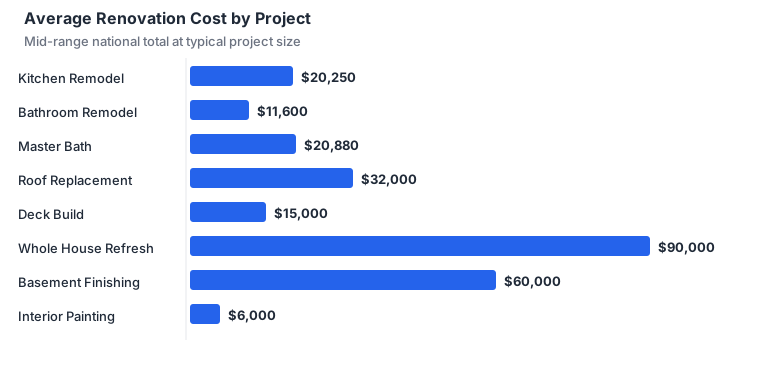
Every successful home renovation starts long before the first wall comes down — it starts with a budget you actually trust. Yet budgeting is where most homeowners stumble, either by anchoring to a number they saw online or by underestimating the dozens of line items that quietly add up. This guide walks you through building a renovation budget from the ground up, so the estimate you set is the estimate you finish with.
Start With What You Can Afford, Not What You Want
The first rule of renovation budgeting is counterintuitive: begin with your financial ceiling, not your wish list. Decide how much you can comfortably spend — from savings, a home equity line, or a renovation loan — before you fall in love with a specific design. This anchors every later decision and prevents the slow "scope creep" that turns a $30,000 kitchen into a $55,000 one.
A common guideline is to keep any single-room renovation under 10-15% of your home's current value, and a whole-house project under 20-25%. Spending far beyond neighborhood norms rarely returns its cost at resale, because a home's value is capped by comparable sales nearby. If your house is worth $400,000, a $90,000 kitchen may be a personal luxury, but it is unlikely to be a sound investment.
Break the Budget Into Categories
A vague total is useless. Split your budget into clear buckets so you can see where money goes and where you can flex. A typical renovation budget allocates roughly:
- Materials (40-50%): cabinets, flooring, fixtures, tile, countertops, appliances.
- Labor (30-40%): demolition, carpentry, plumbing, electrical, finishing.
- Permits & fees (2-5%): building permits, inspections, sometimes design review.
- Design & professional fees (5-15%): architects, designers or engineers if needed.
- Contingency (10-20%): the reserve for surprises — non-negotiable.
These percentages shift by project. A bathroom is labor-heavy because of plumbing and waterproofing packed into a small space, while interior painting is almost all labor and paint. Knowing your category split tells you instantly whether a quote is reasonable or whether a contractor has loaded one bucket.
Why the Contingency Is the Most Important Line
If you remember one thing from this guide, make it this: never start a renovation without a contingency fund of at least 10%, and 20% for older homes. The moment demolition begins, walls reveal their secrets — knob-and-tube wiring, hidden water damage, mold, out-of-code plumbing, or a structural surprise. These are not signs of a bad contractor; they are the nature of renovating existing structures.
Homeowners who skip the contingency face an ugly choice mid-project: pause the work while they scramble for cash, or cut quality elsewhere to cover the overrun. Those who budgeted a reserve simply absorb the surprise and keep moving. Treat the contingency as spent-until-proven-otherwise; if you do not use it, it becomes a welcome bonus, not an expectation.
Get Real Numbers Before You Commit
Online averages are a starting point, not a budget. Costs vary enormously by region, material grade and scope. A kitchen remodel that costs $25,000 in a low-cost Midwest metro can cost $40,000 for the identical scope on the coast, purely because of labor rates. Use a renovation cost calculator to generate a range tailored to your square footage, material grade and state, then collect at least three written contractor bids to validate it.
When you compare bids, make sure they cover identical scope. A suspiciously low bid often excludes demolition, disposal, permits or finish work that competitors included. The cheapest number is meaningless if it is measuring a different project.
Prioritize: Needs, Wants and Nice-to-Haves
Sort every element of your project into three tiers. "Needs" are functional or safety items — a failing roof, unsafe wiring, a non-working furnace. "Wants" are meaningful improvements you will use daily, like a better kitchen layout. "Nice-to-haves" are the extras that inflate budgets: the wine fridge, the imported tile, the smart everything. When the budget tightens (and it usually does), you cut from the bottom of the list, protecting the items that matter most.
This exercise also helps you sequence multi-phase projects. If you cannot afford everything now, tackle the needs and highest-value wants first, and leave the nice-to-haves for a future phase when funds allow.
Understand the Hidden Costs
The line items homeowners forget are remarkably consistent: waste disposal and dumpster rental, temporary housing or eating out during a kitchen remodel, appliance delivery and installation, permit and inspection fees, and the cost of upgrading adjacent areas to match the new work. A gleaming new kitchen can make tired adjacent flooring look worse, tempting you into "while we're at it" additions. Budget for these deliberately rather than discovering them mid-project.
Match Your Timeline to Your Cash Flow
Renovations rarely require the full budget on day one. Materials are ordered in stages, and contractors typically bill on a schedule tied to milestones — a deposit, then payments at framing, rough-in and completion. Never pay in full upfront. A reasonable structure is 10-30% down, progress payments as phases complete, and a final payment only after the work passes inspection and you are satisfied. This protects you and keeps the contractor motivated to finish.
Plan for the Return, Not Just the Cost
A budget is only half the equation; the other half is value. Some projects, like minor kitchen updates, garage-door replacement and fresh paint, recover a large share of their cost at resale. Others, like high-end additions and elaborate primary suites, recover far less. If resale is a priority, weight your budget toward high-ROI improvements. If you are staying long-term, spend on the comfort and function you will enjoy every day — just do it with eyes open about resale.
Build a Simple Budget Spreadsheet
You do not need special software. A simple spreadsheet with columns for each line item, its estimated cost, its actual cost, and the running variance keeps you honest. Update it weekly during the project. The moment actual costs start outpacing estimates, you will see it early enough to adjust — pausing a nice-to-have or renegotiating a material choice — rather than discovering a $10,000 overrun at the end.
Common Budgeting Mistakes That Blow the Number
Most renovation overruns are not caused by one giant surprise — they are the sum of small, predictable errors. The first is budgeting for materials but forgetting that labor usually accounts for 40-60% of a project's total. The second is anchoring to the lowest bid, which frequently omits scope that the other contractors included, so the "savings" reappear later as change orders. The third is treating the contingency as spendable money and burning through it on upgrades before the real surprises arrive. The fourth is ignoring the cost of decisions made mid-project: every time you change your mind after work has started, you pay a premium for it. The fifth is underestimating soft costs — permits, design fees, delivery, disposal and temporary living — that never appear in a per-square-foot rule of thumb. Writing every one of these into the budget from the start turns a hopeful guess into a plan you can actually hold yourself to.
How to Budget When You Don't Know the Final Cost
Early in planning you rarely have firm numbers, and that is normal. Start with a range rather than a single figure: use a cost calculator to establish a realistic low-to-high band for your project type, size and region, then plan against the higher end so you are never caught short. Break the unknown into knowable pieces — get firm quotes for the biggest line items first (cabinetry, structural work, HVAC) because they move the total the most, and estimate the smaller items with wider margins. As real bids come in, replace each estimate with a firm number and watch the range tighten. Keep a running "committed vs. estimated" tally so you always know how much of the budget is locked and how much is still exposed to change. This staged approach lets you commit to the project with confidence long before every last figure is nailed down.
Frequently Asked Questions
How much should I budget for a home renovation?
Budget from your project type and local costs, not a fixed dollar amount. Use a cost calculator to get a realistic range for your square footage, region and material grade, then add 10-20% contingency and the soft costs (permits, design, disposal, temporary living) that per-square-foot estimates leave out.
How much contingency should a renovation budget include?
Set aside 10% for newer homes and straightforward projects, and 15-20% for older homes or anything that opens walls, floors or systems. Older houses hide outdated wiring, plumbing and water damage that only appear once demolition begins.
Does a renovation budget include labor?
Yes — and labor is usually the largest share, running 40-60% of the total. A budget that counts only materials will be off by roughly half, so always price labor and materials together.
What is the cheapest room to renovate?
Interior painting and cosmetic refreshes deliver the most visible change per dollar. Among full rooms, a bedroom or living space is far cheaper than a kitchen or bathroom because it has no plumbing, tile or specialized fixtures.
Can I budget a renovation without contractor quotes?
You can build a solid preliminary budget with a cost calculator, then refine it as bids arrive. Treat the calculator figure as your baseline and expect firm quotes to land within its range; anything far outside deserves a second look.
A Realistic Sample Renovation Budget
Numbers make the process concrete. Imagine a mid-range kitchen remodel with a base construction estimate of $30,000. A well-built budget doesn't stop there. First, add the soft costs most people forget: permits at roughly 3% ($900), design and drawings ($1,500), demolition and dumpster/disposal ($1,800), and delivery and small fees ($600). That brings the working total to about $34,800. Next, protect the project with a contingency — 15% of the construction value, or $4,500 — held untouched for the surprises that appear once the old cabinets and drywall come out. Now the realistic all-in figure is roughly $39,300, nearly a third higher than the headline construction number that first got quoted. This gap is exactly why so many renovations "go over budget" — they never truly counted the full cost. If you also need to eat out or rent a temporary kitchen during the work, add that too. Build your budget this way, from construction cost outward to the last soft cost and reserve, and the final invoice will hold few surprises. Model your own version with a cost calculator, then layer these categories on top to see your true number before you commit.
Key Takeaways
Budgeting a renovation well is less about predicting the future and more about building a plan that survives contact with reality. If you remember nothing else, remember these points as you set your number:
- Start from what you can afford, then shape the scope to fit it — not the other way around.
- Price labor and materials together; labor alone is usually 40-60% of the total.
- Hold a 10-20% contingency and treat it as untouchable until a real surprise appears.
- Count the soft costs — permits, design, disposal, delivery and temporary living — that per-square-foot rules ignore.
- Rank every item as a need, want or nice-to-have so cuts are painless when the budget tightens.
- Validate with real numbers: a cost calculator for the baseline, then at least three matched, itemized bids.
- Refuse change orders once work begins, because each one carries premium pricing.
A renovation budget is a living document, not a one-time guess. Revisit it as bids arrive and decisions firm up, keep a running tally of committed versus estimated costs, and protect the contingency to the end. Do that, and you will spend the project focused on the exciting choices rather than firefighting financial surprises.
Final Checklist Before You Start
- Confirm your financing and total ceiling in writing.
- Break the budget into materials, labor, fees, design and contingency.
- Reserve at least 10-20% for contingency and do not touch it.
- Validate estimates with a calculator and three matched bids.
- Rank every item as need, want or nice-to-have.
- Set a milestone-based payment schedule; never pay in full upfront.
- Track actual vs. estimated costs weekly.
A renovation budget is not a guess — it is a plan. Build it carefully, protect the contingency, validate your numbers, and you will spend the project focused on the exciting decisions instead of firefighting financial surprises. Ready to put real numbers behind your plan? Start with our free renovation cost calculator and refine from there.
Authoritative context: the Bureau of Labor Statistics tracks remodeling labor costs, the IRS publishes home energy tax credits, and HUD lists federal home-repair assistance programs.